

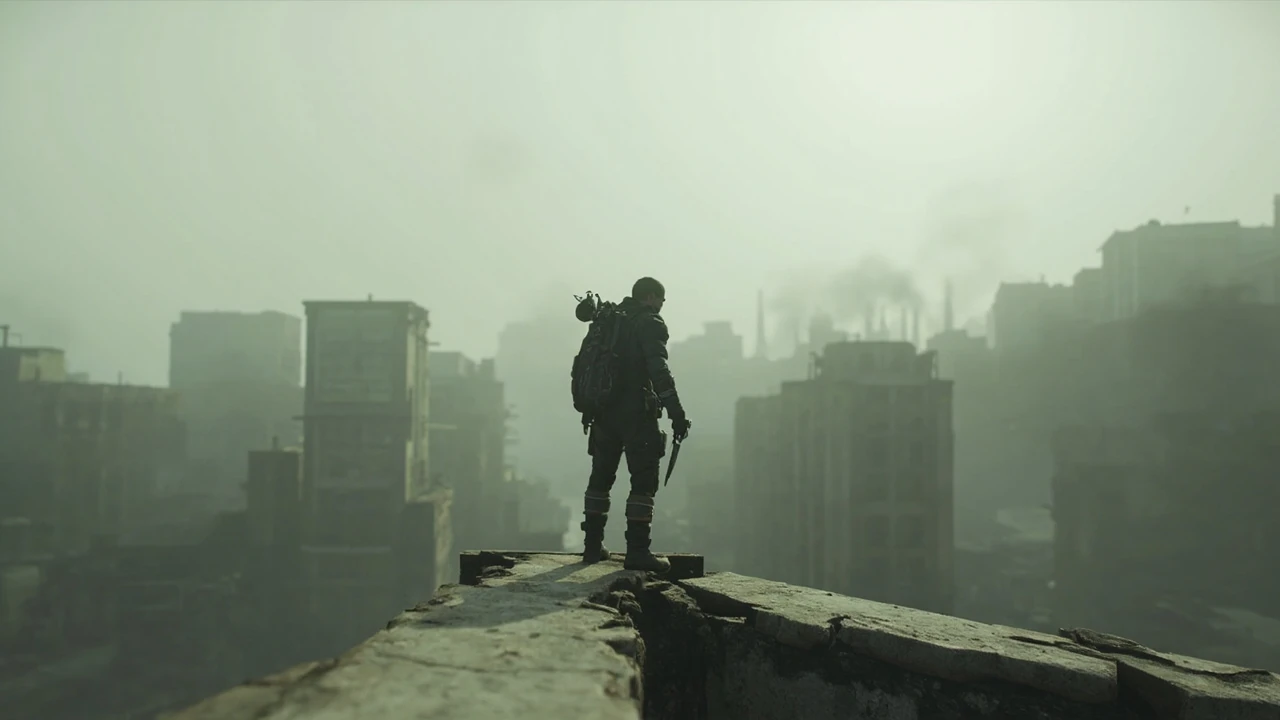
Hell is Us review: how a 38-hour no-map adventure earns its friction
A reviewer’s first honest sentence about Hell is Us is that the game makes you work for its world. The fictional country of Hadea is presented without a minimap, without waypoint markers, and without a glowing breadcrumb trail, and the opening hours are calibrated to make that absence uncomfortable. By the midpoint of Act One, that discomfort turns into a quiet competence, and by the late game the same design feels like the point. That single decision shapes nearly every system in the game, and it is the reason a serious Hell is Us review cannot be written as a generic action-adventure scorecard. Combat, puzzles, story delivery, and pacing are all downstream of the navigation model, so this review treats the no-map structure as the spine and reads the other systems against it.
For developers and players who care about how design intent reaches the player, Hell is Us is a useful case study because its choices are legible. The combat is intentionally simple. The puzzles are intentionally legible to the trained eye rather than to the unguided eye. The story delivery trusts the player to overhear, miss, and revisit. None of this is accidental, and none of it is universally appealing. This review is written for readers who want to understand which decisions hold up under play, which ones only work for a particular temperament, and which systems would benefit from a different default in a future patch or a follow-up project.
What Hell is Us actually asks the player to do
The opening mission establishes three rules and then refuses to repeat them. The first rule is that there is no map and no compass arrow. The second rule is that the world is the puzzle. The third rule is that combat and exploration are the same verb, because most locked doors, dead ends, and shortcuts are gated by what you do when something is already trying to kill you. From a design standpoint, that is a tight contract. From a player standpoint, it is a learning curve that punishes anyone who tries to play Hell is Us the way they would play a modern action-adventure with a glowing quest marker.
The game signals its contract through restraint rather than tutorial. There is no voiced guide telling you to look up, look behind, or read a sign. There is no objective log screaming the next step. There is only a hand-drawn-feeling journal, occasional NPC dialogue, and the physical layout of the streets, tunnels, and apartment blocks. When a reviewer says the early hours feel like riding a bike without training wheels, that is not a complaint about the lack of a map so much as an observation that the game expects the player to internalize a new spatial grammar before the story trusts them with the rest of its world.
Combat: simple, readable, and deliberately limited
Combat in Hell is Us is built around a small kit. You have a short blade, a longer weapon, a firearm that is rarely the right answer, and a drone-like companion that handles healing, scanning, and a small set of utility functions. The enemies are humanoid, slow on the approach, and lethal if you stand still. The combat does not ask you to learn combos, and it does not ask you to memorize a dodge window. It asks you to read the screen, manage your stamina, position yourself relative to two or three threats at once, and commit to a swing only when the geometry says it is safe.
That is a deliberate choice, and it is the kind of choice that reads cleanly to developers even when it frustrates players. The encounter design is the same shape every time: an open arena, a small group, a hazard in the floor or the walls, and an enemy that punishes panic. The encounters are tuned so that a careful player clears them in two to four minutes, while a rushing player can drain every healing charge in the same fight. The system is a measure of patience, not a measure of mechanical depth, and the game is honest about that. Anyone expecting a Devil May Cry-style skill curve will read the combat as thin. Anyone who enjoys the discipline of a Souls-lite encounter will read it as honest.
How the combat system maps to a player’s first ten fights
- Encounter 1 to 3: The game teaches spacing and stamina. Healing charges are plentiful, so failure is cheap and the player learns the rhythm.
- Encounter 4 to 6: Mixed groups appear. The player has to pick a target, manage two angles, and learn that the firearm is for emergencies, not for primary damage.
- Encounter 7 to 10: Environmental hazards enter the arena. The player now has to clear space before swinging, which is the moment combat starts to feel earned rather than performed.
Puzzle design: legibility, not guidance
The puzzles in Hell is Us are the strongest argument for the no-map design. The world is full of things that look like background detail and behave like a clue. A mismatched window frame, a set of coat hooks that points at a missing item, a child’s drawing taped to a fridge, and a statue with a missing piece are all puzzles, and they are all in places the player would walk past if the game marked them. The puzzle design rewards visual literacy and penalizes the assumption that a locked door is decoration.
What makes the design defensible is that the clues stack. By the second act, the player is reading environments the way the game wants to be read, and the puzzles stop feeling like hunts and start feeling like conversations with the level designer. That shift is real, and it is the single biggest reason the back half of the game feels more confident than the front half. The downside is that players who get stuck rarely have a fair hint system to fall back on. There is a soft nudge, but it does not point at a specific object, so a player who does not have the right mental model can wander for an hour.
From a production standpoint, the puzzle density is a budget decision. A large number of environmental puzzles in a non-linear map means a large number of authored states per zone, and a large number of fallback paths when the player solves a puzzle in the wrong order. Hell is Us commits to that budget. The cost shows up in the form of softlocks, missed triggers, and the occasional dead-end that a more guided game would have patched with a fast-travel point.
The no-map design as a design decision, not a gimmick
The most common framing of Hell is Us is that it is a retro choice in a modern wrapper, and that framing misses the point. The decision to remove the map is not nostalgia. It is a constraint that forces the player to learn the geography of Hadea as a place, and that learned geography is what makes the late game land. A player who has internalized the layout of the central district can predict where a door leads, which route to take back to a vendor, and which shortcut opens after a specific quest. That is not a gimmick. That is a payoff that a guided game cannot deliver because a guided game never asks the player to build the mental map in the first place.
The trade-off is real. A first-time player will burn hours on dead ends. A returning player will notice that the world design still does not survive a long break, because the landmarks are realistic rather than iconic. A player with a cognitive load issue, a visual processing difference, or limited session time will struggle in a way that the game does not acknowledge. The developers chose a specific audience, and the rest of the design is consistent with that choice.
What the no-map design gets right
- Player-owned navigation: The map is built in the player’s head, which makes the world feel owned rather than rented.
- Puzzle integration: Because the world is the puzzle, the puzzles do not break the explorer’s flow the way a separate puzzle room would.
- Back-half pacing: The midpoint of Act One is the moment the design starts to feel fair, and that moment is real.
Where the no-map design strains
- First-hour friction: The opening hours punish players who try to play the game the way they would play its peers.
- Softlock risk: Missed triggers and unclear door states can trap a player in a zone they have already cleared.
- Accessibility gap: The design does not provide a directional assist for players who need one, and the lack of a default assist is a real limitation.
Story delivery: a country as the antagonist
The For additional context, narrative spine of Hell is Us is straightforward on paper. The protagonist, Remi, is an exile who was smuggled out of Hadea as a child and returns to find his family missing and his country trapped in a supernatural war. The supernatural element is honest about its purpose: it is a device that turns political violence into a literal monster, and the game uses that device to argue that the worst thing in the country is not the monsters. The argument is not subtle, and the game does not pretend to be subtle about it. It says what it is about, and then it trusts the player to do the work of paying attention to where that argument shows up in the environment.
That delivery model is the second-hardest thing to love about Hell is Us. The dialogue is functional, the voice performances are competent, and the cinematic beats are restrained. None of it lands unless the player reads the side material, and most of the side material is delivered as overheard conversation, environmental writing, and recoverable notes. A player who treats the game as a combat-and-puzzle product will get a complete combat-and-puzzle product. A player who treats it as a country study will get a country study with monsters in it. The game is honest about which one it is, and the reviewer is honest about which one the player has to choose.
Pacing across the three acts
The campaign runs roughly thirty-eight hours, which is long by modern action-adventure standards and short by RPG standards. The act structure is clear, and the pacing is the part of the design that ages the worst. The first act is the slowest, because it is teaching the no-map system and the puzzle grammar at the same time. The second act is the densest, because the player’s mental map is fresh and the environment is at its most rewarding. The third act is the shortest, and it trades exploration for momentum. That trade is a defensible choice, but it is also the moment a returning player notices that the back half of the map has fewer optional threads than the front half.
For a developer, the pacing is the most interesting thing to study. The lesson is not that the no-map design is too slow. The lesson is that a no-map design needs a different pacing curve than a guided design, because the player’s competence curve is steeper and the design has to budget for the moment the player crosses it. Hell is Us budgets for that moment, and the budget is visible in the act-two density. A follow-up project that wants to keep the no-map design would benefit from a longer act two and a tighter act three.
Combat, puzzle, and exploration at a glance
| System | Player verb | Design intent | Where it shines | Where it strains |
|---|---|---|---|---|
| Combat | Position, swing, retreat | Measure patience and reading | Mid- to late-act arenas | Long sessions without healing charges |
| Puzzle | Scan, read, connect | Treat the environment as a clue | Back-half zones with stacked hints | First-time players with no model yet |
| Exploration | Walk, return, recognize | Build a mental map of Hadea | Second act and side districts | Breaks longer than a week |
| Story | Listen, read, infer | Use Hadea as the antagonist | Overheard dialogue and notes | Players who skip side material |
| Companion | Scan, heal, flag | Lower the combat cost of reading | Tutorial zone and boss arenas | Long fights where charges run dry |
Who Hell is Us is built for, and who will bounce off it
The game is built for a specific reader of games, and the rest of this review is for that reader. If you like a game that treats you as the agent of your own navigation, you will get a forty-hour reward out of Hell is Us. If you like a game that hands you a quest log and a compass arrow, you will bounce off the opening hours and you will not be wrong to do so. The reviewer who spent the time to learn the grammar of Hadea is not the reviewer who is best placed to tell a different reader that the game is for them. The most honest way to put it is that Hell is Us is a game that asks for a particular kind of attention and rewards that attention with a particular kind of satisfaction, and the design is internally consistent about that contract.
For developers, the audience question is the production question. A no-map design narrows the audience. It also raises the bar on environmental authorship, on puzzle stacking, and on softlock recovery. A team that wants to ship a no-map game in 2026 has to budget for all three, and the budget is visible in Hell is Us. The game is not the most expensive production on the shelf, and it does not need to be. It needs to be honest about the contract it is offering, and it is.
How the 38-hour runtime breaks down
| Phase | Approximate share of runtime | Player task | Design priority |
|---|---|---|---|
| Act One (early) | Around 25 percent | Learn navigation, grammar, and combat spacing | Teach without telling |
| Act One to Act Two (mid) | Around 35 percent | Build the mental map and stack puzzle hints | Reward returning to a place |
| Act Two (late) | Around 25 percent | Pursue side threads and optional zones | Densest content of the campaign |
| Act Three | Around 15 percent | Resolve the narrative and clear the final arenas | Trade exploration for momentum |
What Hell is Us teaches a studio about navigation design
The most portable lesson is that a no-map design is not a feature, it is a system. A team that wants to ship one has to design the level around the player’s mental model, not around the player’s minimap. Doors have to be readable from the player’s position, not from the designer’s overhead view. Shortcuts have to be honest about the time they save, and the time they save has to be visible from the player’s position too. The game does most of this well, and the parts it does well are the parts that survive a second playthrough.
The second portable lesson is that a no-map design punishes a design team that relies on a UI to fix a level. A level that cannot be read from the player’s position is a level that needs to be rebuilt, not a level that needs a tooltip. Hell is Us occasionally forgets that lesson, and the moments it forgets are the moments the player is most likely to softlock. A follow-up project would benefit from a level-of-detail pass that asks, for every locked door, whether the player can read the door’s purpose without context.
The third lesson is that a no-map design changes the QA pass. A guided game can rely on a journal entry to recover a player. A no-map game cannot, because the journal is the map. The QA pass has to test whether a player can recover from a missed trigger without a UI recovery path, and the answer in Hell is Us is that the player can recover, but only because the geography is dense enough to offer a second route. That density is expensive, and the expense is the reason more games do not ship this way.
What Hell is Us teaches a player about reading a level
For a player, the lesson is that a level can be a teacher. The game never tells the player to look up, but the player who looks up will see a beam that points to a rooftop, and the rooftop will be a path, and the path will be the answer. The game never tells the player to read a sign, but the sign will name a district, and the district will be the same district the player has been walking through for an hour. The game never tells the player to count doors, but the player who counts doors will notice that a building has one too many, and that one too many is a puzzle. None of this is unique to Hell is Us, but the game is unusually consistent about teaching it, and that consistency is what makes the back half of the campaign feel earned.
What the game does not need a player to accept
A serious review has to name the things the game does not need a player to accept. The first is the lack of an accessibility assist for navigation. A directional cue is not the same as a map, and a high-contrast landmark layer is not the same as a waypoint. The second is the third-act pacing trade, which is a defensible choice but a real one. The third is the softlock surface, which is a function of the no-map budget and not a betrayal of the design. A player who goes in knowing these three things will read the game more fairly than a player who goes in expecting the game to read them.
How Hell is Us compares to its design siblings
Hell is Us is a sibling of games that trust the player to read a level. It is not a Souls-like in the mechanical sense, because the combat is too simple to belong in that family. It is not a survival horror in the resource sense, because the healing economy is too generous. It is a sibling of games that treat the level as the primary verb, and the closest references in the wider catalogue are the exploration-led entries in the Resident Evil and God of War families, which is why those references are the right ones for a first-time player to bring to the game. A useful comparison set for a developer is the Resident Evil 4 walkthrough, because it treats the village as a teachable place rather than a backdrop, and that treatment is the same contract Hell is Us is offering. For a player who wants a written companion, the Resident Evil 4 walkthrough on Trivoxa Studios reads the village with the same level of attention that Hell is Us asks the player to read Hadea with, and that parallel is the cleanest way to set expectations before a first session. The shared design contract also explains why a player who bounces off Hell is Us is more likely to bounce off the open-village sections of Resident Evil 4 than off a guided corridor shooter, and that bounce is information, not a failure.
Frequently asked questions
How long is Hell is Us?
A first playthrough on a standard difficulty runs roughly thirty-eight hours, with the front half taking longer per objective than the back half because the no-map design rewards returning to a place the player has already learned. A returning player who already knows the geography can finish the campaign in noticeably less time, and a completionist run that pursues every side thread and every optional zone will spend more time in the second act than in the first and third combined.
Is Hell is Us a Soulslike?
No. The combat is too simple to belong to the Soulslike family, and the healing economy is too generous to support a Soulslike resource curve. The game shares a patience-first design contract with the Soulslike family, and it shares a level-reading contract with the classic Resident Evil and God of War entries, but it does not share the mechanical depth that defines a Soulslike. A player who goes in expecting dodge windows and combo trees will read the combat as thin, and a player who goes in expecting a patience measure will read it as honest.
Why does Hell is Us have no map?
The no-map design is the spine of the game, not a feature on top of it. By removing the map, the design forces the player to learn the geography of Hadea as a place, and that learned geography is what makes the late game land. The trade is real: first-time players will burn hours on dead ends, and players with limited session time will struggle. The game is honest about that contract, and the rest of the design is consistent with it.
What kind of puzzles does Hell is Us have?
The puzzles are environmental. A mismatched window frame, a set of coat hooks that points at a missing item, a child’s drawing on a fridge, and a statue with a missing piece are all puzzles, and they are all in places the player would walk past if the game marked them. The design rewards visual literacy and penalizes the assumption that a locked door is decoration. The clues stack, and by the second act the player is reading environments the way the game wants to be read.
Is the combat in Hell is Us hard?
The combat is not mechanically hard, but it is punishingly honest. The encounters are tuned so that a careful player clears them in two to four minutes, while a rushing player can drain every healing charge in the same fight. The system is a measure of patience, not a measure of mechanical depth, and the difficulty is the moment a player stops trying to play the game the way they would play a modern action-adventure and starts playing the game the way the game wants to be played.
Can you get softlocked in Hell is Us?
Yes, in the same way a player can get softlocked in any game that trusts the level to do the teaching. A missed trigger, an unclear door state, or a puzzle solved in the wrong order can leave a player in a zone they have already cleared. The softlock surface is a function of the no-map budget, and the design offers a soft nudge rather than a hard recovery path, so a player who is stuck should look for an environmental hint rather than wait for a UI cue.
Should I read any guides before starting Hell is Us?
A first-time player will get more out of the campaign by reading the environment than by reading a guide, and a guide that solves the puzzles in advance will remove the only thing the back half of the game is selling. A returning player who has bounced off the game once can use a written companion to read the level with the same attention the game asks for, and a developer who wants to study the design can read a design breakdown that treats the no-map system as the spine. The right preparation is a willingness to read the level, not a list of answers.
What platforms is Hell is Us on, and does it run well?
Hell is Us ships on the platforms announced by the publisher at launch, and a player who wants the cleanest first session should match the platform to a controller they already trust, because the combat is built around a controller-friendly input layer. A player who is sensitive to frame pacing should check a current performance review before purchase, because the no-map design punishes a session that is interrupted by a frame drop in the middle of a read, and the campaign is long enough that a bad first hour will cost more than it would in a shorter game. The publisher’s official page is the right place to confirm the current platform list, the current patch level, and any platform-specific notes before a purchase decision, and the page that has been most useful to this reviewer for launch and patch context is the Hell is Us review on IGN, which has been kept current with patch notes and platform-specific notes since launch.
Is the story in Hell is Us worth the time?
The story is the part of the game that ages the best on a second playthrough, because the second playthrough is the playthrough that has the mental map. The narrative argues that the worst thing in the country is not the monsters, and the game uses its supernatural device to make that argument literal. The argument is not subtle, and the game does not pretend to be subtle about it. A player who treats the game as a country study will get a country study with monsters in it. A player who treats it as a combat-and-puzzle product will get a complete combat-and-puzzle product and a thin story.
Who should skip Hell is Us?
A player who needs a compass arrow to enjoy a campaign should skip the game, because the no-map design is the spine and the rest of the design is consistent with it. A player who wants a deep mechanical combat system should skip the game, because the combat is a measure of patience rather than a measure of mechanical depth. A player who wants a tightly guided story should skip the game, because the story is delivered as overheard dialogue and recoverable notes rather than as a guided cinematic. A player who wants a forty-hour reward out of a level-reading design should play the game, because that contract is what the design is honest about, and the rest of this review is for that player.



Leave a Reply