

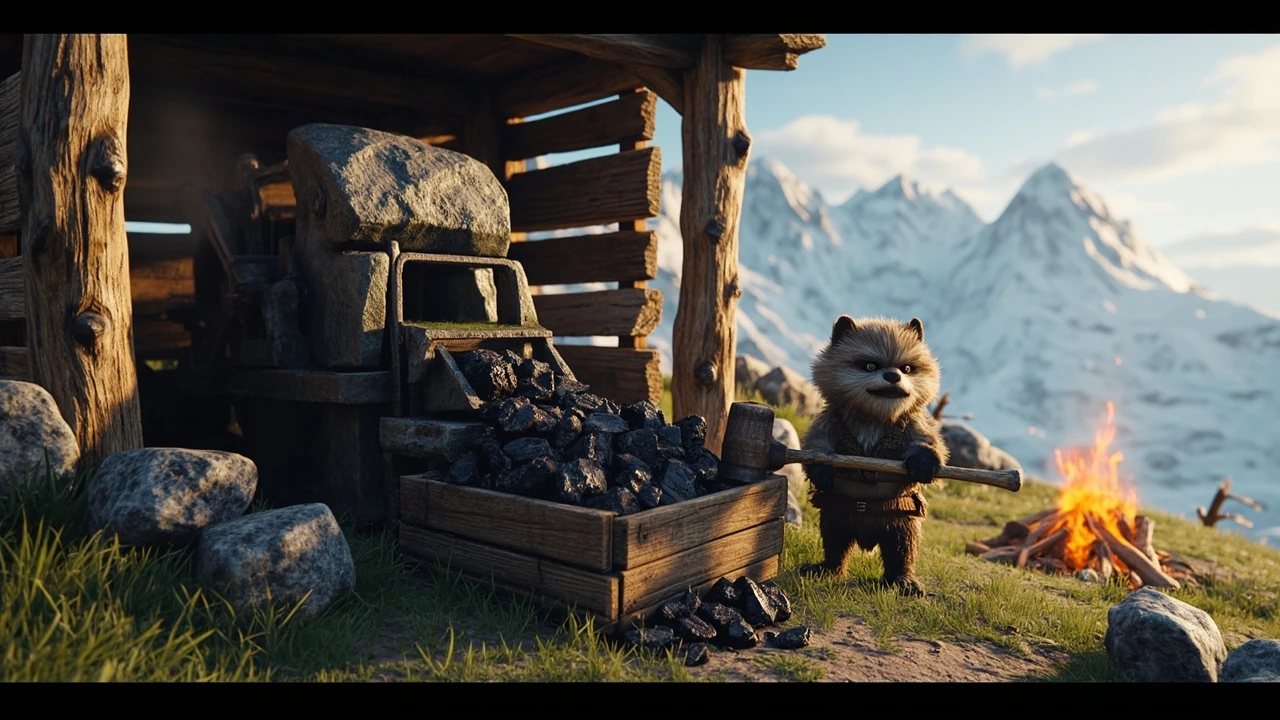
Palworld coal: where to find it, farm it, and use it efficiently
Coal is one of the early-mid resources that quietly decides how fast a Palworld base can scale. Smelters, refined ingots, ammunition, and several high-tier crafting chains all rely on it, and the moment you try to push into steel or modern technology, the lack of a steady coal supply becomes the bottleneck. The good news is that the resource economy in Palworld 1.0 was rebalanced so that coal no longer behaves like a rare drop. It now exists as a mineable node, a Pal drop, and an automated base output, which means there are three practical ways to keep a stockpile growing without grinding for hours.
This guide focuses on the engineering question behind that supply line: which source fits which stage of a playthrough, how the Coal Quarry fits into a base layout, and which design choices actually matter once automation is online. The goal is to leave you with a clear plan rather than a list of every node on the map.
What coal is actually used for in Palworld
Coal in Palworld is a refined crafting input, not a raw mined commodity on its own. Before you commit to a farming route, it helps to map the consumption so you know how much you really need. Coal shows up in the following production paths, each with a different burn rate:
- Smelting ore into refined ingots at a Primitive Furnace, Improved Furnace, or Electric Furnace.
- Ammunition and explosive recipes that require refined carbon.
- Several high-tier technology unlocks that demand coal as part of their material cost.
- Fuel for specific industrial buildings added in later updates.
Of these, furnace smelting is the dominant consumer in any serious base. Every metal ingot that leaves your refinery has a coal cost built in, so the moment a base starts producing ingots at scale, coal becomes a background dependency that needs to be solved rather than ignored.
Wild coal nodes vs. Pal drops vs. base automation
There are three legitimate ways to get coal, and each one fits a different stage of a playthrough. The table below summarizes the trade-offs so you can pick the right source for the moment instead of running between biomes.
| Source | Best stage of game | Output rate | Setup cost | Limitation |
|---|---|---|---|---|
| Wild coal nodes | Early to mid game, before Level 37 | Moderate, depends on pickaxe tier | None, just a pickaxe and travel time | Respawn timers and node density vary by biome |
| Defeating specific Pals | Mid to late game, when those Pals are reachable | Low per kill, but stackable with other grinds | Combat prep, possibly a raid summon | Locked behind specific biomes or raid mechanics |
| Coal Quarry at base | Level 37 and beyond, the long-term answer | High and consistent, passive | 5 Ancient Technology Points, plus building materials | Requires a Mining-type Pal assigned to the quarry |
For most players, the realistic path is to use wild nodes to get past the early furnace wall, then switch to the Coal Quarry as soon as it unlocks. The Pal-drop route is best treated as a supplement during specific farming sessions rather than a primary supply.
Finding wild coal nodes after the 1.0 update
Before the 1.0 patch, setting up an entire base dedicated to one resource was a common workaround because nodes were sparse. The 1.0 update made coal nodes more common across the map, so players who prefer exploration can find workable deposits in several biomes without needing a dedicated base. The general pattern is that coal nodes tend to cluster near rocky outcrops and cliff faces, with higher density in colder and volcanic regions.
When you go out to mine manually, three habits make a real difference in how much coal you bring home per run:
- Carry a metal-tier pickaxe. Output scales with tool quality, and the time saved across a route adds up fast.
- Mark dense node clusters on the map as you find them so future runs are repeatable instead of exploratory.
- Travel with a Pal that can carry heavy loads, since coal stacks quickly and weight becomes the real limit before inventory slots do.
For exact node coordinates, IGN’s dedicated coal locations reference stays the most reliable community-maintained source, since spawn data has shifted between updates and the map itself is large enough that listing every cluster in a single article would go out of date quickly.
Pal drops: which Pals give coal and where to find them
Defeating or capturing specific Pals is the second coal source, and it ties into how the resource economy rewards combat encounters. As of the 1.0 update, three creatures are worth targeting for coal drops, and they all share a single location, which makes the grind easier to plan.
| Pal | Type | Location | Notes |
|---|---|---|---|
| Blazamut | Fire-type boss Pal | Flamepulse Islet, far east of the map | Found in the wild, high combat difficulty |
| Blazamut Ryu | Fire-type raid boss | Summoned via a crafted Summoning Altar | Requires raid prep and dedicated group |
| Pierdon | Neutral-type Pal | Also on Flamepulse Islet | Easier to chain than the Blazamut pair |
Because all three share a biome, a focused farming trip to Flamepulse Islet can be combined with other late-game resource runs in the same session, which is more efficient than bouncing between regions. The honest trade-off is that drop-based farming produces a modest amount of coal per kill, so it is best used as a top-up method rather than a primary supply line.
Setting up the Coal Quarry at your base
The Coal Quarry is the long-term answer, and the reason is straightforward: it converts coal from something you go and get into something your base produces. The building first appeared in the Sakurajima update and was rebalanced for 1.0, so the current requirements are what matter when you plan a tech path.
The unlock conditions are simple but not free:
- Reach player Level 37 before the Ancient Technology option even offers the quarry.
- Spend 5 Ancient Technology Points to actually unlock the recipe.
- Construct the quarry inside an existing base using the required building materials.
Once placed, the quarry does not run on its own. It needs a Pal with a high Mining work suitability assigned to it, and the quality of that Pal directly affects how fast coal accumulates. This is where the real design choice lives, because the same Mining slot could power a stone pit, an ore quarry, or a coal quarry, and the allocation shapes the whole base economy.
Designing a base around the Coal Quarry
A Coal Quarry sitting alone in a corner of a base is a common mistake. For additional context, Coal is heavy, and hauling it manually from the quarry to storage, then to furnaces, eats time even in a small base. The right move is to treat the quarry as one node in a production cluster.
A practical layout has three layers working together:
- Storage chests placed adjacent to the quarry so a high-Mining Pal can deposit directly without a player standing nearby.
- One or more furnaces fed by a transporting Pal from that storage layer, keeping the smelting loop inside the same compound.
- A power grid, typically a coal- or wood-fired generator, that runs the Electric Furnace once the base has graduated past primitive smelting.
Placing the quarry, the storage, and the furnace inside a single enclosed base ensures that the same assigned Pals can move between them, which removes the manual hauling step entirely. It also concentrates the production into a single area that can be defended during raid events, which matters once the base becomes valuable enough to attract attacks.
Choosing the right Pal for the quarry slot
Mining suitability is not a single number, so the question of which Pal to assign is worth thinking through. Pals with higher Mining work suitability will produce coal faster, but they will also be more attractive candidates for other quarries on the same base. The general pattern that holds up across most bases is to use your best Mining Pal on whichever resource is currently the bottleneck.
For an early Level 37 base, this is usually a clear ranking:
- Assign the highest-Mining Pal to the Coal Quarry first, because it feeds the furnaces that everything else depends on.
- Promote secondary Mining Pals to that slot only once the primary candidate is already pulling strong output.
- Resist the temptation to spread one strong Mining Pal across multiple quarries; the system rewards concentration in one assigned building per Pal.
If the highest-Mining Pal in the base is already locked into an ore quarry, the honest answer is to let the coal quarry wait a few levels rather than weaken the ore supply. The smelting chain still works as long as coal production eventually overtakes ore, and forcing the assignment too early tends to starve the furnaces instead of feeding them.
Common problems with coal supply and how to fix them
Most coal problems in a base are actually layout or assignment problems, not scarcity problems. Once wild nodes are dense and the Coal Quarry exists, the resource itself is rarely the issue. The issue is usually one of three things.
First, furnaces idle because a transporting Pal is not prioritized for the coal storage chest. The fix is to make sure the storage box that the quarry feeds is also the box that the furnace transports from, so the loop is closed without player intervention.
Second, the Coal Quarry underperforms because a low-Mining Pal is assigned. The fix is straightforward, but it requires honesty about which Pals actually carry Mining 3 or Mining 4 and which only have a cosmetic mining tag. Replacing a low-tier worker is a one-time cost that pays back across every subsequent production cycle.
Third, the base burns through coal faster than the quarry produces it because the furnace chain has grown without a corresponding power and storage upgrade. The fix is to add more storage and, if the smelting load keeps climbing, to start routing coal toward an Electric Furnace powered by a dedicated generator so the throughput per unit of coal improves. If coal consumption still outpaces production, the right next step is usually to add a second quarry rather than to chase more wild nodes.
Where coal sits in the wider Palworld economy
It is worth stepping back from the immediate farming question to see how coal connects to the rest of the technology tree. Coal is one of those unglamorous resources that everything expensive depends on, in roughly the same way that copper wire underpins a modern factory. Ingots power weapons and armor, refined carbon powers ammunition, and Electric Furnaces powered by generators accelerate the entire chain. When coal supply is stable, the rest of the base feels smooth. When it is not, every other upgrade stalls at the same choke point.
For a single-player or small-coop base, one well-run Coal Quarry combined with a focused furnace cluster is enough to carry the entire mid-game economy. For larger multiplayer operations, the design pattern is to build multiple quarry-equipped outposts so that no single base becomes a single point of failure. The economics do not really change; only the scale does.
Quick checklist for a stable coal supply
Before leaving the topic, it helps to have a short list of checks that covers the most common failure modes. A base that satisfies all of these will rarely run out of coal, even during heavy crafting sessions.
- The Coal Quarry is unlocked, built, and assigned to a high-Mining Pal.
- Adjacent storage chests exist so the quarry can output without manual help.
- At least one furnace is in range of that storage and assigned a transporting Pal.
- Power infrastructure can support the furnace tier the base is currently running.
- The base has at least one redundant route to coal, whether a second quarry or a known wild node cluster, in case a raid event damages the primary supply.
If any of these are missing, the fix is almost always structural rather than grind-based. Adding storage, reassigning a Pal, or moving a furnace closer to the quarry will usually do more for coal throughput than another hour of node mining.
Frequently asked questions
Where is the best place to find coal in Palworld early on?
In the early game, before Level 37, the most reliable answer is to mine wild coal nodes near rocky outcrops and cliff faces. The 1.0 update increased node density across several biomes, so a short exploration loop with a metal-tier pickaxe usually produces enough coal to keep a primitive furnace fed. For exact coordinates, IGN’s coal locations reference is a useful map companion because spawn data has shifted across patches.
Which Pals drop coal in Palworld?
As of the 1.0 update, three Pals are worth targeting for coal drops. Blazamut and Pierdon are both found on Flamepulse Islet in the far east of the map, while Blazamut Ryu is a raid boss that has to be summoned through a crafted Summoning Altar. The drop rate per kill is modest, so this source works best as a supplement to base production rather than a primary supply.
What level do I need to be to unlock the Coal Quarry?
The Coal Quarry becomes available at player Level 37, and only as an Ancient Technology option. Unlocking the recipe costs 5 Ancient Technology Points, on top of the standard building materials required to actually place the structure at a base.
Does the Coal Quarry need a specific Pal to work?
Yes. The Coal Quarry needs a Pal with a high Mining work suitability assigned to it, and the quality of that Pal directly controls how fast coal is produced. A Mining 4 Pal assigned to the quarry will outperform a Mining 1 Pal by a significant margin, so the assignment decision is one of the most important design choices in a mid-game base.
Can I run multiple Coal Quarries in one base?
You can, as long as you have the Ancient Technology Points to unlock additional recipes and enough high-Mining Pals to staff each one. In practice, most single-player bases only need one quarry, but multiplayer operations or bases running very heavy smelting loads often build a second quarry to keep up with consumption.
Is coal still needed once I have Electric Furnaces?
Yes, but the role changes. Electric Furnaces still consume coal to smelt ore, and at higher throughput the demand can actually increase rather than decrease. The Electric Furnace saves manual labor and time, but it does not remove the underlying coal dependency. A stable coal supply becomes more important at that stage, not less.
Should I build my base around coal nodes or near my existing furnace?
Near the existing furnace cluster. Once the Coal Quarry is the primary coal source, relocating the base to chase wild nodes is wasted effort. Building the quarry close to storage and furnaces keeps the production loop tight and lets transporting Pals move coal without player input.
How does coal compare to ore in terms of base priority?
Ore and coal are usually the two resources that bottleneck a base at the same time, and they should be treated as a pair. The general rule is to assign the highest-Mining Pal to whichever resource is currently the bottleneck and rotate that assignment as the base grows. Trying to run both quarries at full speed with weak Mining Pals usually produces less total output than running one well-staffed quarry at a time.
Do raids or boss events affect coal supply?
They can, because raids can damage base structures, including the Coal Quarry and the storage chests it feeds. The reliable defense is to enclose the production cluster inside walls and to keep a backup route to coal, whether a known wild node or a second quarry, so that one bad raid does not stall the entire smelting chain.
What is the fastest way to stockpile coal at the start of a playthrough?
The fastest early-game approach is to combine a focused mining run across two or three known coal node clusters with an early furnace setup that does not yet need Electric Furnaces. Once Level 37 is reached, the Coal Quarry takes over and the early mining route becomes a backup rather than the main supply. Trying to grind coal manually past that point is usually a worse use of time than investing in the quarry and its support infrastructure.




Leave a Reply