

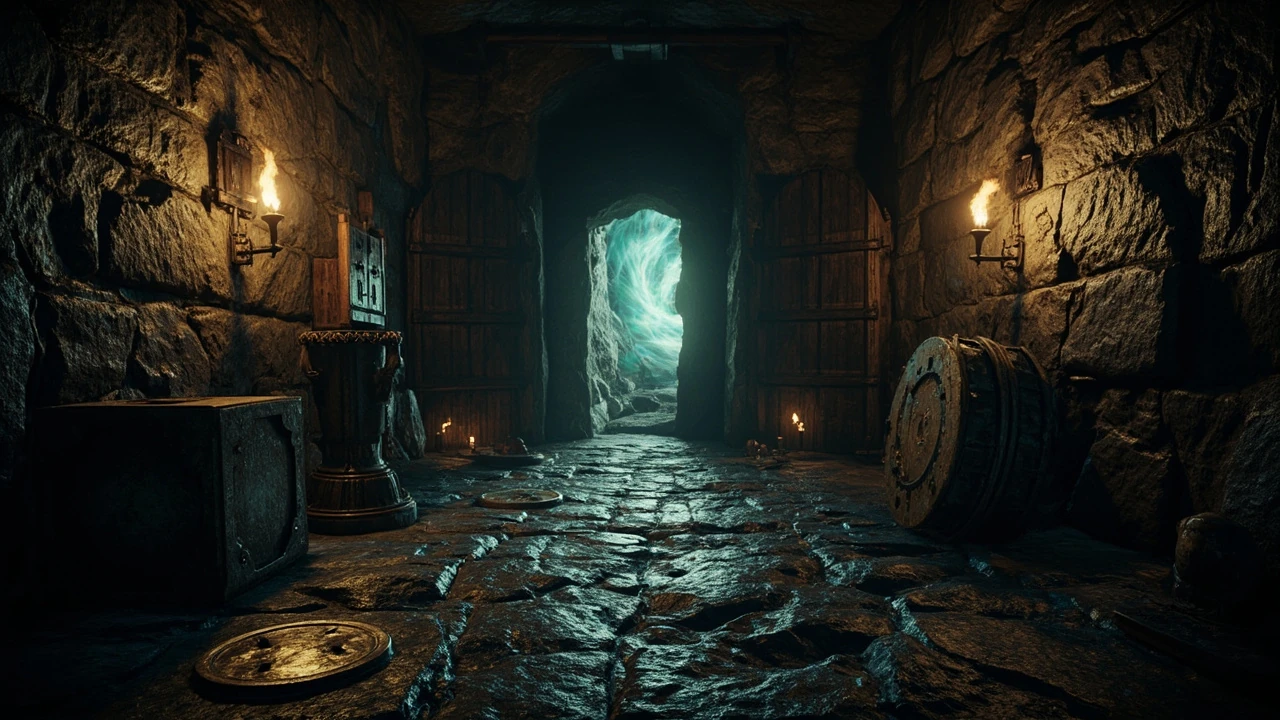
AC Valhalla Tombs of the Fallen: how the expansion is built and how to play it
AC Valhalla Tombs of the Fallen is a free content expansion for Assassin’s Creed Valhalla that added a set of underground puzzle dungeons across the English map. Each tomb hides a sealed burial chamber, and reaching the loot inside means solving a small physics-driven puzzle with pressure plates, sliding pedestals, and portable orbs. For players, the loop is short: find a tomb, get in, open the gate, claim the reward. For developers and design-focused readers, the same content is an interesting case study in optional content, spatial puzzles, and a discovery system built around the raven rather than quest markers.
this page treats the expansion from both sides. The first half is a practical player walkthrough that explains what the tombs are, how to find them, and how each puzzle mechanic works. The second half breaks the content apart as a design artifact: how the team used the raven to replace quest markers, how the puzzle grammar was kept consistent across many tombs, and what trade-offs the team accepted by tying the content to free updates rather than a paid expansion pack.
Every claim below is limited to what has been officially introduced and documented for the title. Where a design observation depends on interpretation, it is labeled as such rather than presented as an official statement.
What Tombs of the Fallen actually adds to the game
Tombs of the Fallen is positioned as free downloadable content, not a paid expansion. It does not introduce a new main story, a new region, or a new weapons tree. Instead, it layers a new optional activity type on top of the existing open world, the way some live-service games add a new seasonal mode without changing the base campaign.
The activity is built from three repeating elements:
- A discovery layer that points the player to a tomb entry point on the world map.
- A traversal and environmental puzzle layer inside an underground chamber.
- A reward layer tied to a sealed burial chamber at the end of the puzzle.
Each tomb is self-contained. There is no quest chain, no NPC who sends you to the next tomb, and no progression gate that forces a particular order. The tombs share the same puzzle grammar but use different layouts, which keeps the experience readable while leaving room for the world to feel exploratory rather than linear.
For developers, the most useful framing is that Tombs of the Fallen is an “activity pack” in the same architectural sense as a side-mode in a sports game or a new dungeon type in an MMO. The base engine, animation set, and world streaming system stay the same; the team adds new level art, new puzzle logic, and new placement rules on top of them.
How to unlock and find tombs in the open world
According to the official DLC guide, the tombs become available as soon as you have started your settlement at Ravensthorpe. There is no quest associated with them, and therefore no quest marker pointing at their location. Discovery is left to the player.
The discovery system uses the raven as a sensory layer separate from Eivor. When the raven is anywhere near a tomb, a large spire of swirling blue-green smoke appears in the air above it. This spire is not visible to Eivor on the ground; only the raven can perceive it. At the base of the spire is a stone face carved with a symbol that has been identified as Odin’s Illusionary Rune, representing camouflage and deception.
Approaching the symbol and interacting with it makes the stone face disappear and reveals a cave entrance. From there, the player follows the cave into a large underground chamber and begins the puzzle phase.
The practical sequence is therefore:
- Reach Ravensthorpe and unlock the settlement at the start of the main story.
- Send the raven to survey regions of England.
- Watch for the blue-green smoke spire that marks a tomb.
- Fly Eivor to the rune stone and interact with it to expose the entrance.
- Enter the cave and clear the puzzle to reach the burial chamber.
Because the marker is tied to the raven rather than to the compass, players who rarely use the bird can easily miss entire tombs. That design choice is one of the more interesting parts of the expansion and is discussed in the design section below.
The puzzle grammar: pressure plates, pedestals, and flanged orbs
Every tomb in the expansion shares the same internal logic. The underground chamber contains a closed gate on one side, with a gold seal across it. Beyond the gate is the burial chamber and its loot. To open the gate, the player has to satisfy pressure plates on the chamber floor.
There are two pressure plate types, and both must usually be active at the same time:
- Square pressure plates, which require a stone pedestal to be slid on top of them.
- Round pressure plates, which require a flanged orb to be carried and placed on them.
The challenge is not in operating the plates themselves; both interactions are a single button press. The challenge is in finding the pedestals and the orbs, which are often hidden behind breakable walls, inside smaller side rooms, or on raised platforms, and then physically moving them back to the plates.
The flanged orb is the more demanding object. It is heavy enough that Eivor carries it with both hands, and while carrying it the player cannot climb, cannot use a bow, and cannot perform most of the usual parkour moves. That means a tomb with two or three orbs in awkward positions quickly becomes a logistics puzzle: where do I drop this orb so I can climb back up and get the next one, and how do I keep it from rolling into a pit?
Pedestals are lighter and behave more like crates. They can be pushed and pulled, and they do not block combat in the same way. They are usually used for square plates that are obvious from the start, so the orb handling tends to be the gating mechanic in any given tomb.
What the rewards actually are
The expansion is not designed around a single headline reward. The loot pool is spread across the tombs so that each one is worth doing on its own. The standard payout is a piece of gear or a piece of cosmetic content that ties into the tomb’s burial theme. Because there is no quest, completing a tomb does not advance a tracker, unlock a follow-up cutscene, or change the world state.
That reward structure is consistent with the rest of the open world. AC Valhalla already runs on a “small reward per discovery” model for most of its side content, and Tombs of the Fallen sits inside that model rather than breaking out of it with a single, large payoff.
For players who are thinking about long-term character planning, this matters. A completed tomb is a small bump rather than a build-defining drop, so the value of doing every tomb is in the cumulative set of small upgrades and cosmetics, not in any one item.
Update history and how the expansion was rolled out
Tombs of the Fallen was introduced as free content with title update 1.4.0 and then expanded on with title update 1.6.1. The split release matters for two reasons.
First, it explains why some players who returned to the game after a long break saw a wave of new markers on their map that were not there when they left. The map symbols and raven spires only show up once the relevant patch is installed, and the count of available tombs grew when 1.6.1 was deployed.
Second, the free-update framing constrained the design. Because the content is not sold, it does not have a standalone price tag, a store page, or a marketing trailer of its own. It has to justify itself on play time and on the value of its rewards, which is why the puzzles are short and the reward tier is mid-range rather than endgame.
The patch numbering also tells a small production story. The team used 1.4.0 to ship the first batch of tombs and the discovery layer, then used 1.6.1 to add more tombs and the settlement dialogue that acknowledges the activity. That two-step rollout kept the original patch small and let the second patch act as a soft relaunch once the team had feedback from the first batch.
AC Valhalla Tombs of the Fallen as a level design case study
For developers and technical artists, the most useful way to read the expansion is as a study in how a team can extend a large open world with a small amount of new logic. The tombs reuse the existing cave and rock-climbing system, the existing interaction system, and the existing inventory. What is new is the puzzle grammar and the discovery layer.
That reuse is what makes the design economical. The team did not have to author a new traversal system or a new object type; it had to define two new object behaviors (pedestal on plate, orb on plate) and one new discovery channel (raven spire plus rune stone). Once those rules exist, every tomb is mostly a layout problem.
For a small studio working on a similar activity pack, the lesson is to spend design effort on the grammar, not on the individual levels. Once the grammar is fixed, levels are mostly an art and layout problem that can be batched out.
Why the raven is doing the work a quest marker usually does
In most open-world games, optional content is marked by a compass icon, a waypoint, or a question mark on the HUD. AC Valhalla uses a different convention: a large, world-scale visual effect that only the raven can see. The player still has to fly to the right area, but the visible feedback is diegetic to the bird rather than to the protagonist.
That choice has trade-offs. It rewards players who already use the raven as a scouting tool, and it makes the discovery feel grounded in the world rather than in the interface. It also penalizes players who never use the raven, because they will see no on-screen indicator of tombs they have walked past. For a design team, that is an intentional accessibility trade: the discovery channel is rich for engaged players and thin for players who skip the bird, instead of being a uniform but abstract marker for everyone.
Puzzle layout as a constrained grammar
Each tomb is a small, sealed arena with a known kit: pedestals, orbs, plates, one gate, one reward. The constraint set is small enough that the designers can build many tombs without each one needing bespoke mechanics. The variation comes from spatial arrangement rather than from new verbs.
| Element | Type | Role in puzzle | Implementation cost |
|---|---|---|---|
| Square pressure plate | Trigger volume | Receives a pedestal to count as satisfied | Reuses existing crate-style interaction |
| Round pressure plate | Trigger volume | Receives a flanged orb to count as satisfied | New “heavy carry” state on the player controller |
| Pedestal | Movable prop | Slid onto a square plate | New geometry, reuses push and pull logic |
| Flanged orb | Heavy movable prop | Carried and placed on a round plate | New geometry, new carry state, animation set |
| Gold-sealed gate | Conditional door | Opens when all plates are satisfied | Reuses standard door logic with extra condition |
| Blue-green smoke spire | World-space effect | Discovery layer visible only to the raven | New particle system, new perception channel |
| Rune stone face | Interactive prop | Disguises the cave entrance until activated | New mesh, new interaction state |
The grammar is narrow on purpose. Once a designer is told “one square plate, one round plate, one orb, one pedestal, one gate,” the layout problem is solvable. The same grammar across many tombs is also what lets players learn the system quickly: by the second or third tomb, the question stops being “what does this object do” and becomes “where is the second orb hidden.”
Player guidance: a short practical checklist
For readers who are mainly here to play the content, the shortest reliable answer is to fly the raven across any region of England, look for the blue-green smoke spire, and follow it down to the rune stone. Inside the chamber, the rule is “all plates must be active at once.” Everything else is layout.
- Start the Ravensthorpe settlement before hunting tombs. The content is locked behind the settlement, not behind a power level.
- Use the raven first. Walking past a tomb on foot gives no on-screen hint that one is nearby.
- Treat orbs as your main bottleneck. Plan a route that drops each orb on a plate rather than carrying it across the whole chamber in one go.
- Watch for breakable walls and side rooms. Pedestals and orbs are often hidden behind cracked stone that the raven’s perception can reveal.
- Do not expect quest progression. The expansion does not advance a questline, so there is no “you have finished” moment beyond the individual tomb completion.
How the expansion fits into the wider live-update plan
AC Valhalla shipped with a long post-launch plan that combined paid expansions such as Wrath of the Druids and Siege of Paris with free content updates. Tombs of the Fallen is part of the free side of that plan, alongside seasonal festivals and river raids-style modes.
Free content of this kind has to clear a higher bar for self-containment. A paid expansion can rely on a new region, a new story, and a new progression system to give the content a sense of identity. A free activity pack has to communicate what it is from the discovery layer alone, and it has to remain fun for players who might do one tomb per play session rather than a full evening of it.
That is one reason the puzzle loop is short. A tomb can be entered, solved, and looted in roughly the same time it takes to clear a single fort, which is the established “small session” unit in the base game. It is also why the rewards are mid-range rather than top-tier; the designers are not trying to push players to grind tombs, only to make each one feel worth the detour.
For a reader building a mental model of the post-launch plan, the simplest way to place Tombs of the Fallen is “free, optional, short-session, no quest.” That single sentence captures almost every design decision in the expansion, from the puzzle length to the reward tier.
Common failure cases and how to recover
Even with a narrow puzzle grammar, players run into a small set of recurring problems. None of them require restarting the tomb; the chamber and its objects are persistent for the duration of the visit.
| Symptom | Likely cause | What to check |
|---|---|---|
| The gold-sealed gate will not open | One or more plates are not active | Walk the chamber perimeter and confirm every square and round plate has a matching object on it |
| The orb keeps rolling off the plate | The orb is placed slightly off-center or on a sloped floor | Lift and re-place the orb so its base sits flat on the round plate’s center |
| The pedestal will not slide onto a plate | A wall, breakable crate, or raised step is blocking the path | Clear the route of debris first, then push the pedestal along the longest flat surface you can find |
| The chamber has fewer objects than the plate count suggests | One of the objects is hidden in a side room or behind a cracked wall | Use the raven’s perception to highlight breakable walls, then check ledges above the main floor |
| You cannot carry the orb up a ledge | The heavy-carry state blocks climbing | Drop the orb on a flat surface, climb the ledge, find a route back, then re-pick the orb from a higher vantage point |
| No blue-green spire appears anywhere on the map | The relevant title update is not installed | Check your installed patch version against the latest AC Valhalla title update for your platform |
| The rune stone does nothing on interaction | Eivor is still outside the raven’s detection radius | Move the raven directly above the stone and confirm the spire is centered before interacting |
The recovery pattern is the same in every case: walk the full chamber, find the missing object, and place it correctly. The expansion is not designed to soft-lock, so if a gate does not open it is a configuration problem on the player’s side rather than a bug.
What this expansion does well, and where it could have gone further
From a design perspective, the expansion’s strength is its consistency. The puzzle grammar is the same in every tomb, the discovery channel is the same, and the reward tier is the same. That consistency is what lets players build mental models quickly, and it is what keeps the cost of building many tombs low. A team that wanted to ship five tombs and a team that wanted to ship fifteen tombs could use the same rule set.
The most defensible critique is that the discovery layer is too thin for players who do not already use the raven. A player who never sends the bird out will see no indication that a tomb is within walking distance, and the only feedback is the absence of feedback. A small on-screen hint, such as a faint world-space icon when Eivor is within a set radius of a rune stone, would have lowered that barrier without breaking the diegetic feel of the raven.
The other obvious limitation is reward variety. Because each tomb pays out the same kind of loot, players who do one or two quickly see the upper bound of the reward pool and lose some of the motivation to clear the rest. A rotation of reward categories, or a small meta-progression that filled in as more tombs were completed, would have extended the loop without breaking the short-session design.
Both points are interpretive. The team that shipped the expansion was working under the constraints of a free update layered on a large, already-shipped open world, and they chose consistency and reach over surprise and progression. That trade-off is reasonable, but it is also where a similar future activity pack in another game could differentiate itself.
One small note for readers who care about production cost rather than player experience: the same constraints also explain the absence of a dedicated NPC. Adding a quest-giver would have meant new voice work, new barks, and a new quest tracker entry, all of which are heavy changes for a free update. Skipping the NPC is a cheaper way to ship the same content.
Comparing the puzzle loop to other AC Valhalla activities
It helps to set the tombs against the other optional activities in the same open world. Cairns, standing stones, and flyting all sit in the same “short session, small reward” bucket, but they are observational or timing-based rather than spatial. A cairn is a camera puzzle, a standing stone is a platforming challenge, and a flyting contest is a dialogue duel.
Tombs are the only optional activity in the base open world that combines a discovery layer, a spatial puzzle, and a movable-object mechanic. That combination is what gives the tombs their own identity, and it is also why they read as a small game within the game rather than as a checklist of small interactions.
For developers, the comparison is useful because it shows how a small, well-bounded activity can occupy a niche that is not served by the existing activity types. A team designing a similar pack does not have to invent a new genre; it has to find an empty cell in the existing activity matrix and fill it.
A short note on the rune iconography
The symbol on the stone face has been identified as Odin’s Illusionary Rune, which in the game’s iconographic system represents camouflage and deception. From a narrative standpoint, that fits the tombs well: each entrance is hidden in plain sight, and the player has to use a perception channel (the raven) that the protagonist does not have access to in order to find it.
From a level design standpoint, the rune also functions as a visual key. Every tomb uses the same carved symbol, so a player who learns to recognize it once will spot the same pattern at every other site. That kind of repeating iconography is a cheap way to teach the player what a tomb looks like without adding a tutorial pop-up or a UI element.
What the source material confirms and what it leaves open
The official DLC guide covers the mechanics, the discovery flow, and the update history in enough detail to support every player-facing claim here. It does not, and is not expected to, comment on the team’s internal design rationale, so the production and level-design analysis above is presented as interpretation rather than as confirmed intent. The same applies to reward numbers, drop rates, and exact tomb counts across patches: those details live in the patch notes rather than in the guide, and the guide itself stops at the gameplay layer.
Frequently asked questions
Do I need to own any DLC to play Tombs of the Fallen?
No. The expansion is free content introduced in title update 1.4.0 and expanded on in title update 1.6.1, so it is available to any player who has the relevant update installed and who has reached the Ravensthorpe settlement in the main story.
How do I find a tomb if there is no quest marker?
Send the raven out to fly over the area you want to explore. When the raven is near a tomb, a large spire of swirling blue-green smoke appears in the air. The spire is not visible to Eivor on the ground, so the raven is the only way to see it. Fly to the base of the spire to find the rune stone that opens the entrance.
What is the symbol on the rune stone, and does it matter?
The symbol has been identified as Odin’s Illusionary Rune, which is themed around camouflage and deception. It is a thematic marker rather than a gameplay gate; you only need to interact with it to make the stone face vanish and reveal the cave entrance.
What is the difference between a square pressure plate and a round one?
Square plates are activated by sliding a stone pedestal onto them, and round plates are activated by placing a flanged orb onto them. Most tombs require both types to be satisfied at the same time before the gold-sealed gate opens.
Why is carrying the orb so restrictive?
The orb puts Eivor into a heavy-carry state. While carrying it, you cannot climb, cannot use a bow, and cannot perform most parkour moves. That is by design: the orb is meant to be a slow, deliberate object, and the restriction is what makes finding a route to its plate the real challenge of a tomb.
Is there any story or NPC attached to the tombs?
No. There are no quests associated with Tombs of the Fallen and therefore no quest markers. The activity is presented as pure exploration and puzzle content, and any narrative flavor comes from the burial theme of each individual chamber rather than from a connecting storyline.
Do tombs scale with my power level, or are they static?
The tombs are static content with a fixed reward tier, similar to other mid-range discoveries in the open world. They are not designed as endgame content, and the loot is not gated behind a power-level check.
Can I leave a tomb in the middle of a puzzle and come back?
Yes. The chamber and its objects are persistent for the duration of your visit, and you can leave and return through the cave entrance without losing your progress on the puzzle.
How many tombs are there in total?
The base set was introduced with update 1.4.0 and the expansion was extended with update 1.6.1. The exact count of tombs added across both updates is part of the live patch notes rather than a fixed design document, so the most reliable source for the current number is the in-game count under the tombs category on the world map, or the official patch notes for your platform.
Is Tombs of the Fallen worth doing if I am near the end of the main story?
It depends on what you want. The expansion is a good source of mid-range gear and a short, repeatable puzzle loop, and it is worth doing for players who enjoy the spatial-puzzle side of AC Valhalla. It is not a high priority for players who are only interested in the main story or the paid expansions, because the rewards do not affect the ending of the campaign.


Leave a Reply